
Understanding Directional, Dynamic, and Condenser Microphones for Podcasting
If you're shopping for a podcast microphone, the terminology can get confusing pretty quickly.
Dynamic. Condenser. Directional. Omnidirectional. Cardioid.
I've been learning a lot more about microphones while recording my podcasts, reaction videos, and screen recordings with Podsplice.
I'm going to clear this all up for you right now.
The first thing to understand is that these terms don't all describe the same thing.
Dynamic vs. condenser describes HOW the microphone works.
Directional vs. omnidirectional describes WHERE the microphone picks up sound.
Once you understand that difference, microphone terminology becomes much easier.
Directional vs. omnidirectional microphones
The easiest way to understand this is to think about a flashlight versus a lightbulb.
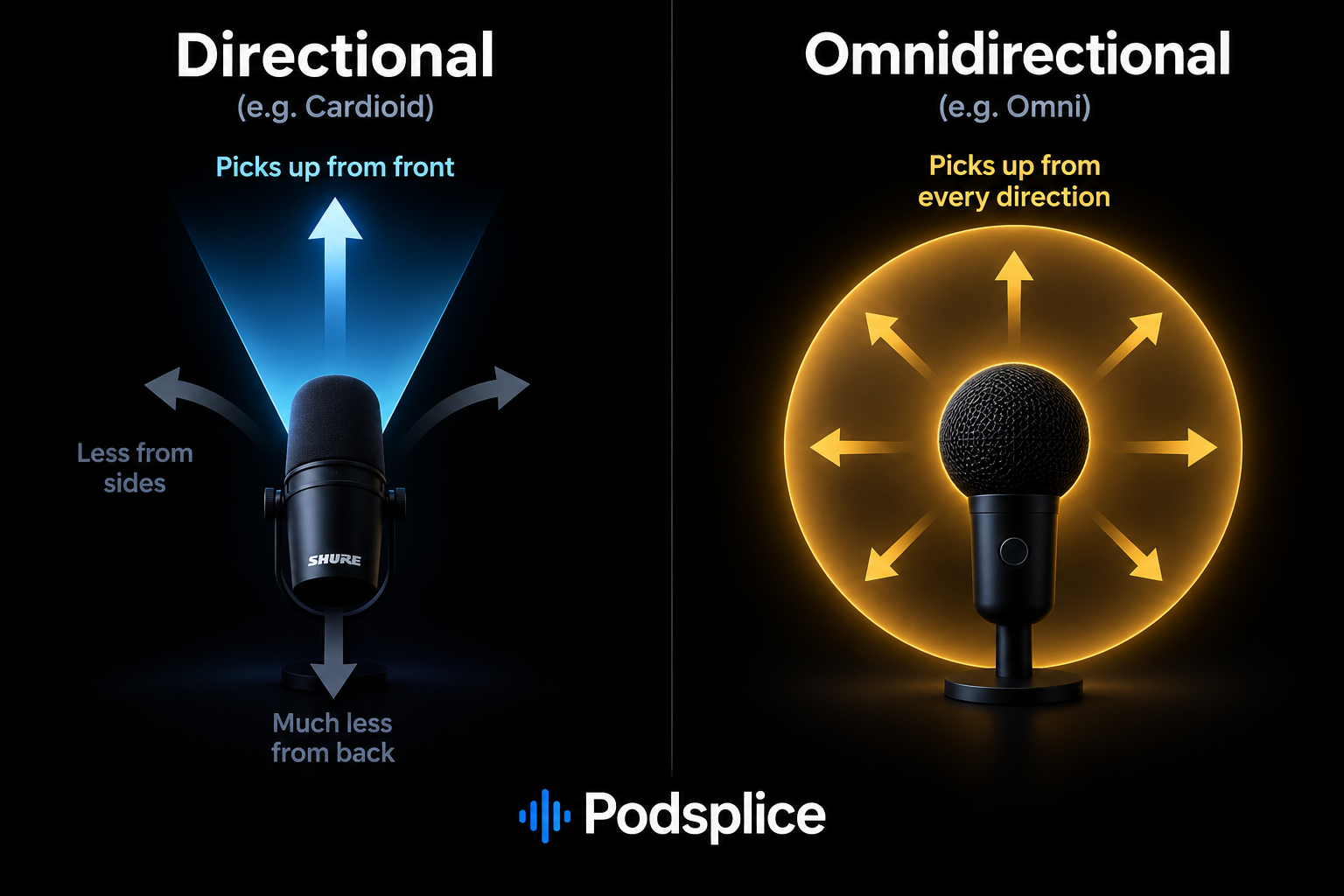
A directional microphone is like a flashlight. It focuses mainly in one direction.
An omnidirectional microphone is more like a lightbulb. It picks up sound relatively evenly from all around it.
For podcasting, I really like the idea of a directional microphone.
Think about it.
When I'm recording a podcast or screen recording, I already know exactly where the important sound is coming from:
My mouth.
I'm sitting directly in front of the microphone. I'm not moving all over the room. I want it to pick up my voice as clearly as possible while picking up less of my computer fan, room reflections and echoes, HVAC, and other sounds coming from around me.
A directional microphone doesn't magically know which sounds are background noise. It simply picks up sound more strongly from some directions and rejects more sound from others.
For a podcaster sitting in one position, that's a huge advantage.
When is an omnidirectional microphone useful?
Sometimes you actually want to record sound coming from every direction.
Imagine four people sitting around a table with one microphone in the middle.
In that situation, an omnidirectional microphone could make a lot of sense because there isn't one single direction containing all the important sound.
Omnidirectional microphones can also be useful when you're intentionally trying to capture the sound of an entire environment.
For my normal podcasting setup, though, I'm usually one person speaking from one predictable position, so directional makes a lot of sense.
Also, any high-quality podcast that has several people sitting around a table would give each participant their own directional mic to use.
Note: If you want great sound for your screen recordings and podcasts, software matters a lot more than you think. Podsplice is amazing at recording the highest-quality audio possible.
Dynamic vs. condenser microphones
This is a completely different question.
Dynamic and condenser describe how the microphone turns sound into an electrical signal.
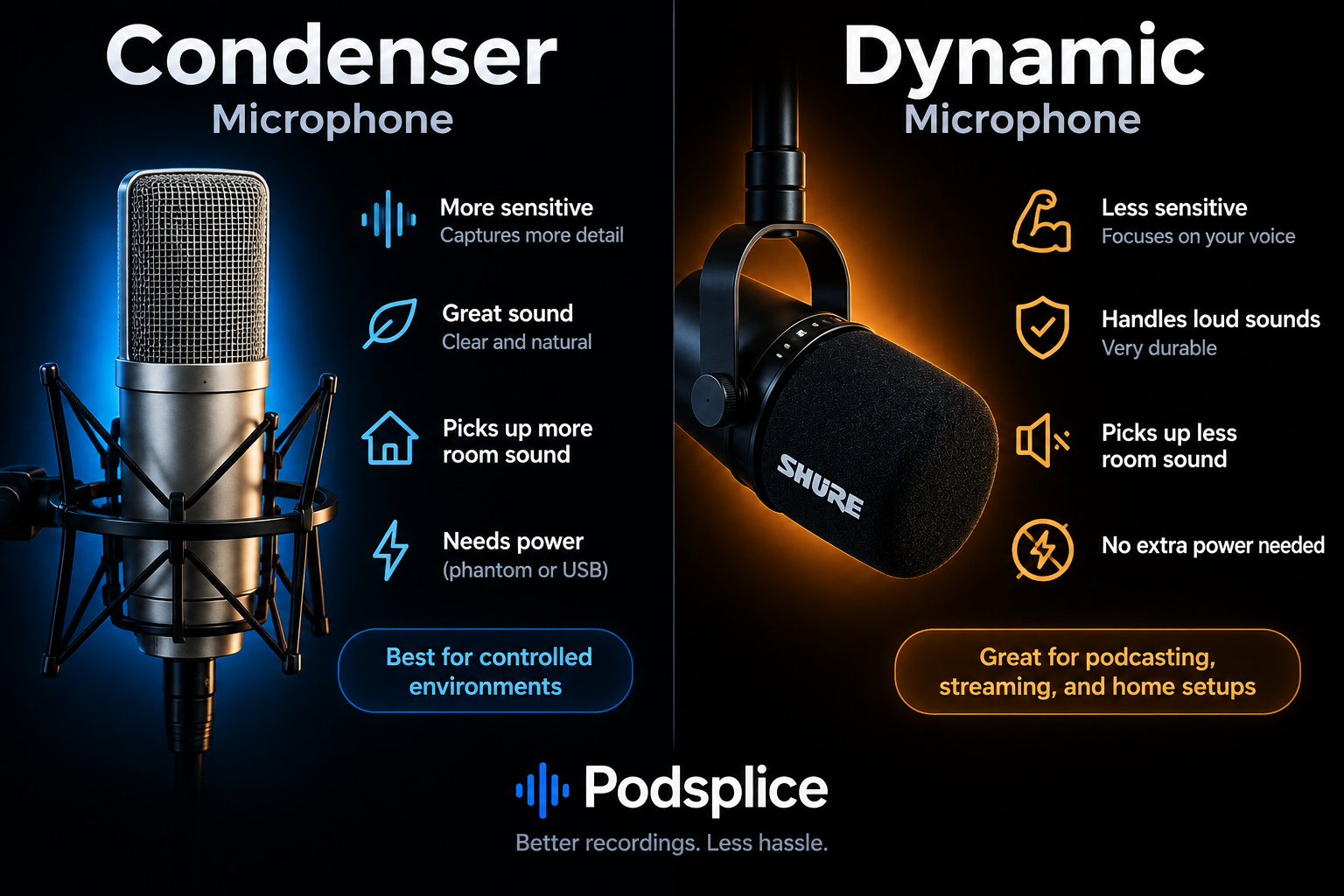
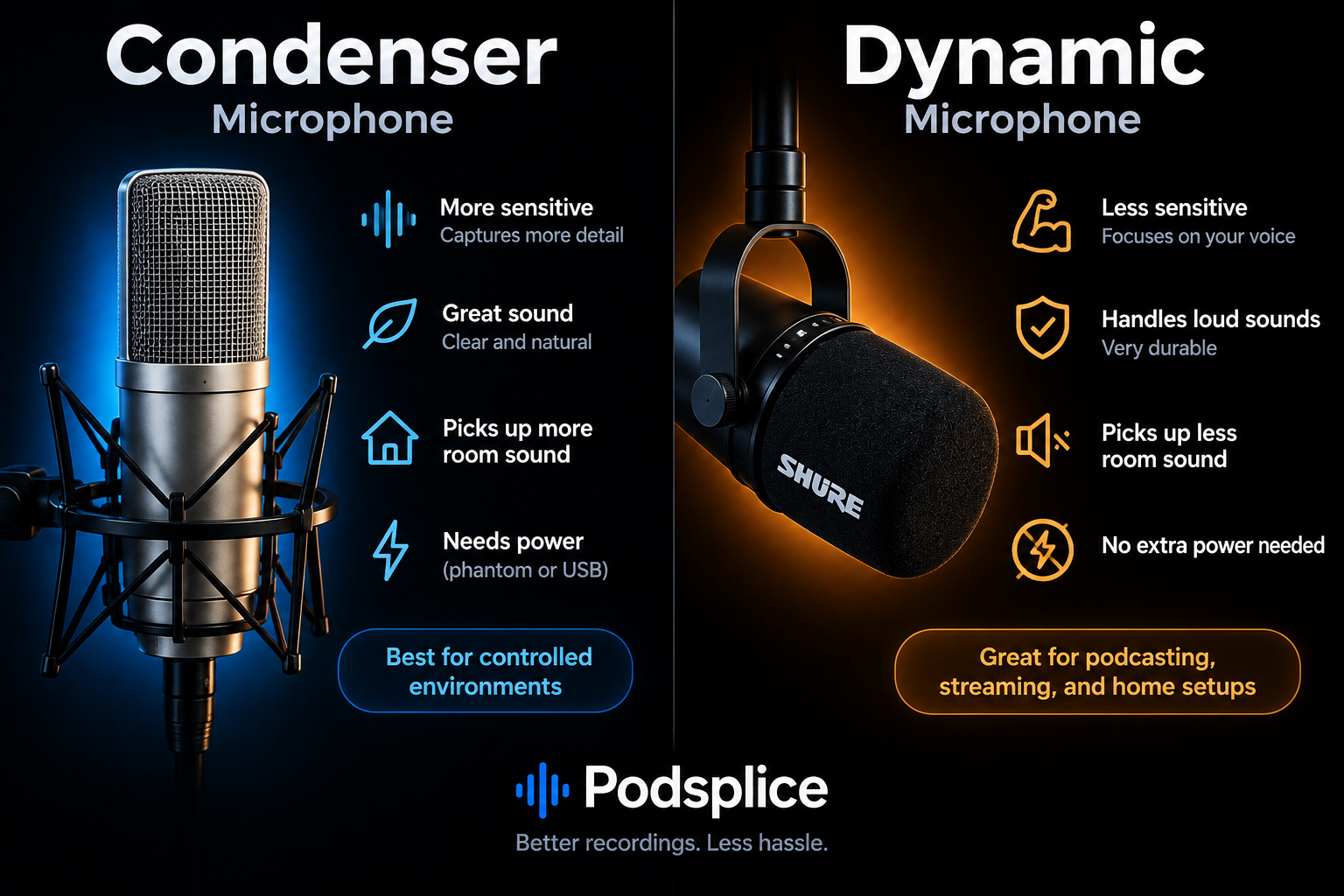
A dynamic microphone typically uses a diaphragm attached to a small coil that moves within a magnetic field.
A condenser microphone uses a very thin diaphragm near a backplate, creating a capacitor whose electrical properties change as the diaphragm moves.
You don't really need to understand all of that physics to record a podcast.
The important thing is that both can produce excellent audio.
Dynamic microphones are extremely common for podcasting, broadcasting, and live vocals. They're often used close to the speaker and can work very well in normal home recording environments.
Condenser microphones are often very sensitive and detailed. They can sound fantastic, especially in a controlled recording environment, but that sensitivity can also make your recording setup and room more important.
And here's the important part:
A dynamic microphone can be directional.
A condenser microphone can also be directional.
These are two separate characteristics.
The Shure MV7+ I'm currently using with Podsplice, for example, is both dynamic AND directional.
In general, I would recommend a dynamic mic for podcasters or YouTubers recording at home. I'd be more likely to consider a condenser mic if I had a super quiet, acoustically controlled recording space, which most people don't.
Here is a video of me using Podsplice and my Shure mic together. Listen to it with headphones.
Directional microphones also have a cool proximity effect
There is another reason I like directional microphones for podcasting.
Many of them exhibit something called the proximity effect.
As you move very close to the microphone, the lower frequencies in your voice become stronger relative to the rest of the sound.
That can make your voice sound deeper, warmer, fuller, and more like that classic radio voice.
Move farther away and much of that extra low-end boost disappears.
Of course, you can get too close. Too much proximity effect can make your voice sound boomy or muddy, and you can also get nasty blasts of air from P and B sounds.
But with the right distance, proximity effect can be a really useful tool for podcasting.
So what does cardioid mean?
Finally, you'll often see the word cardioid when shopping for microphones.
Cardioid is simply one type of directional pickup pattern.
The word comes from the roughly heart-shaped area around the microphone where it is most sensitive.
Very simply:
Front = strongest pickup
Sides = weaker pickup
Back = strongly reduced
My Shure MV7+ uses a cardioid pickup pattern.
This is the least important term to understand of all the terms I mentioned in this article. It is basically just the shape or pattern of where the mic is most sensitive.
So we can now describe it in several ways without those terms contradicting each other:
It is dynamic.
It is directional.
And its directional pickup pattern is cardioid.
What should you use for podcasting?
Don't look at a microphone and ask only whether it is dynamic or condenser.
Also look at where it picks up sound.
For the way I normally record with Podsplice—one person speaking from a known position directly in front of the microphone—a directional cardioid microphone makes a lot of sense.
The easiest way to remember all of this is:
Dynamic vs. condenser = HOW the microphone works.
Directional vs. omnidirectional = WHERE the microphone listens.
Cardioid = one TYPE of directional pickup pattern.
Once you understand those three things, choosing a podcast microphone becomes a lot less confusing.
Check out why a good mic is not the only thing to consider for podcast audio - software is important too.

About the Author
Andrew Best
Andrew Best is an entrepreneur, educator, and AI expert with over two decades in online marketing. He co-founded China232 — a podcast and learning platform with 10M+ downloads — and later 88Herbs, a premium supplement company. Andrew now focuses on helping creators leverage AI for podcasting, screen recording, and YouTube content through Podsplice.
More from Podsplice
Remove Ambient Background Noise From Your Videos
Article
How to Make Reaction Videos on a Mac: The Easiest Way in 2026
Article
How to Record YouTube Audio on Mac (The Easiest Way in 2026)
Article
Record System Audio on Mac and Windows
Article
Bandicam vs Podsplice: Which Is Better for Content Creators in 2026?
Article
Start Recording in Seconds
No downloads. No setup. Just hit record and share your story with the world in studio quality.
Looking for a Screen Recorder or Remote Recording tool?